Virtues of the Day of Arafaah
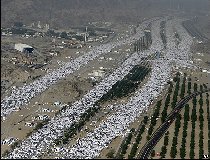
It was narrated on the authority of ‘Aa’ishah  that the Prophet
  said: “There
is no day when Allah sets free more slaves from Hell than the Day of
‘Arafah. He draws near, then boasts of them to the angels, Saying, ‘What
do these [slaves] want [that I may give them]?’” [Muslim]
said: “There
is no day when Allah sets free more slaves from Hell than the Day of
‘Arafah. He draws near, then boasts of them to the angels, Saying, ‘What
do these [slaves] want [that I may give them]?’” [Muslim]
that the Prophet said: “There
is no day when Allah sets free more slaves from Hell than the Day of
‘Arafah. He draws near, then boasts of them to the angels, Saying, ‘What
do these [slaves] want [that I may give them]?’” [Muslim]
It was narrated by Abu Hurayrah  that the Prophet said: “Allah
boasts about the people of ‘Arafah to the dwellers of heaven, saying,
‘Just look at My slaves! They have come to Me with disheveled hair and
covered in dust.’” [Ahmad in his Musnad, Ibn Hibbaan in his Saheeh and Al-Haakim in Al-Mustadrak]
that the Prophet said: “Allah
boasts about the people of ‘Arafah to the dwellers of heaven, saying,
‘Just look at My slaves! They have come to Me with disheveled hair and
covered in dust.’” [Ahmad in his Musnad, Ibn Hibbaan in his Saheeh and Al-Haakim in Al-Mustadrak]
that the Prophet said: “Allah
boasts about the people of ‘Arafah to the dwellers of heaven, saying,
‘Just look at My slaves! They have come to Me with disheveled hair and
covered in dust.’” [Ahmad in his Musnad, Ibn Hibbaan in his Saheeh and Al-Haakim in Al-Mustadrak]
It was narrated by Jaabir that the Prophet said: “There is no better day in the Sight of
Allah than the Day of ‘Arafah. Allah The Almighty descends [on that
day] to the lowest heaven, and boasts about the people of the earth to
the dwellers of heaven, saying: ‘Just look at My slaves! They have come
to Me with disheveled hair and covered in dust, standing in the
forenoon. They have come from every distant pass. They seek My Mercy
although they have not seen My punishment.’ There is no day when Allah
sets free more slaves from Hell than the Day of ‘Arafah.’” [Ibn Khuzaymah, Ibn Hibbaan, Al-Bazzaar, Abu Ya‘la and Al-Bayhaqi]
that the Prophet said: “There is no better day in the Sight of
Allah than the Day of ‘Arafah. Allah The Almighty descends [on that
day] to the lowest heaven, and boasts about the people of the earth to
the dwellers of heaven, saying: ‘Just look at My slaves! They have come
to Me with disheveled hair and covered in dust, standing in the
forenoon. They have come from every distant pass. They seek My Mercy
although they have not seen My punishment.’ There is no day when Allah
sets free more slaves from Hell than the Day of ‘Arafah.’” [Ibn Khuzaymah, Ibn Hibbaan, Al-Bazzaar, Abu Ya‘la and Al-Bayhaqi]
Ibn ‘Umar said that two men went to the Prophet to ask him about matters of religion and the Prophet said to them: “As for the standing at ‘Arafah, Allah The Almighty descends
to the lowest heaven and boasts of the people there to the angels
saying, ‘Here are My slaves! They have come to Me with disheveled hair
and covered with dust, from every distant pass. They seek My Mercy and
fear My Punishment, although they have not seen Me. And what [would be
their state] if they had seen Me!’ [Even] if you have sins like [the
number of grains of] sand, the [number of] days of the worldly life or
the [number of] drops of rain, Allah will [nevertheless] erase them for
you.” [Musannaf ‘Abdur-Razzaaq]
said that two men went to the Prophet to ask him about matters of religion and the Prophet said to them: “As for the standing at ‘Arafah, Allah The Almighty descends
to the lowest heaven and boasts of the people there to the angels
saying, ‘Here are My slaves! They have come to Me with disheveled hair
and covered with dust, from every distant pass. They seek My Mercy and
fear My Punishment, although they have not seen Me. And what [would be
their state] if they had seen Me!’ [Even] if you have sins like [the
number of grains of] sand, the [number of] days of the worldly life or
the [number of] drops of rain, Allah will [nevertheless] erase them for
you.” [Musannaf ‘Abdur-Razzaaq]
Anas said,
said,
I was with the Prophet at Al-Khayf mosque and a man from the Ansaar [helpers] and another one from the Thaqeef tribe came to him. The Prophet said a long statement and part of what he said was: “As for the standing at ‘Arafah: Allah The Almighty descends to the lowest heaven
[on that day], and boasts about you to the angels, saying: ‘Here are My
slaves! They have come to Me with disheveled hair and with pale faces
seeking My Mercy and Forgiveness. If your sins are as many as the grains
of sand or the drops of rain or [as much as] the foam on the sea, I
would forgive you. Go My slaves after being forgiven, and after the ones
whom you asked forgiveness for have been forgiven.” [Ibn ‘Abdul-Barr]
at Al-Khayf mosque and a man from the Ansaar [helpers] and another one from the Thaqeef tribe came to him. The Prophet said a long statement and part of what he said was: “As for the standing at ‘Arafah: Allah The Almighty descends to the lowest heaven
[on that day], and boasts about you to the angels, saying: ‘Here are My
slaves! They have come to Me with disheveled hair and with pale faces
seeking My Mercy and Forgiveness. If your sins are as many as the grains
of sand or the drops of rain or [as much as] the foam on the sea, I
would forgive you. Go My slaves after being forgiven, and after the ones
whom you asked forgiveness for have been forgiven.” [Ibn ‘Abdul-Barr]
It was narrated on the authority of Anas that he said,
that he said,
The Prophet stood at ‘Arafah and the sun was about to set, so he said: “O Bilaal, call the people.” Bilaal stood up and asked the people to listen to the Prophet so they listened. The Prophet said:
“O people, Jibreel [Gabriel] came a while ago, delivered the greetings
of Allah to me and said, ‘Allah has forgiven the people of ‘Arafah and
the people of the Mash‘ar [a place in Muzdalifah].’” ‘Umar got up and
asked the Prophet “Is this specific to us?” The Prophet said: “This is for you and all the people who come after you until the Day of Judgment.” ‘Umar, replied, “The goodness of Allah is plentiful and wonderful.” [Ibn ‘Abdul-Barr]
stood at ‘Arafah and the sun was about to set, so he said: “O Bilaal, call the people.” Bilaal stood up and asked the people to listen to the Prophet so they listened. The Prophet said:
“O people, Jibreel [Gabriel] came a while ago, delivered the greetings
of Allah to me and said, ‘Allah has forgiven the people of ‘Arafah and
the people of the Mash‘ar [a place in Muzdalifah].’” ‘Umar got up and
asked the Prophet “Is this specific to us?” The Prophet said: “This is for you and all the people who come after you until the Day of Judgment.” ‘Umar, replied, “The goodness of Allah is plentiful and wonderful.” [Ibn ‘Abdul-Barr]
The Significance of these Ahadeeth:
In his explanation of Saheeh Muslim, Imam An-Nawawi  said, “This Hadeeth explicitly indicates the virtue of the Day of ‘Arafah.” An-Nawawi combined
the understanding of the Ahadeeth that deal with the virtue of the Day
of ‘Arafah and the Ahadeeth that deal with the virtue of Friday such as
the Hadeeth that says: “The best day that the sun rises upon is Friday.”
[Muslim] He said that the Ahadeeth that deal with the virtue of the Day
of ‘Arafah show that ‘Arafah is the best day of the year, while the
Ahadeeth that deal with the virtue of Friday show that it is the best
day of the week.
said, “This Hadeeth explicitly indicates the virtue of the Day of ‘Arafah.” An-Nawawi combined
the understanding of the Ahadeeth that deal with the virtue of the Day
of ‘Arafah and the Ahadeeth that deal with the virtue of Friday such as
the Hadeeth that says: “The best day that the sun rises upon is Friday.”
[Muslim] He said that the Ahadeeth that deal with the virtue of the Day
of ‘Arafah show that ‘Arafah is the best day of the year, while the
Ahadeeth that deal with the virtue of Friday show that it is the best
day of the week.
said, “This Hadeeth explicitly indicates the virtue of the Day of ‘Arafah.” An-Nawawi combined
the understanding of the Ahadeeth that deal with the virtue of the Day
of ‘Arafah and the Ahadeeth that deal with the virtue of Friday such as
the Hadeeth that says: “The best day that the sun rises upon is Friday.”
[Muslim] He said that the Ahadeeth that deal with the virtue of the Day
of ‘Arafah show that ‘Arafah is the best day of the year, while the
Ahadeeth that deal with the virtue of Friday show that it is the best
day of the week.
It was narrated on the authority of Saalim ibn ‘Abdullah ibn ‘Umar that he saw someone begging on the Day of ‘Arafah, so he said to him, “What a strange thing! On this day you are asking someone other than Allah?”
that he saw someone begging on the Day of ‘Arafah, so he said to him, “What a strange thing! On this day you are asking someone other than Allah?”
‘Umar ibn ‘Abdul-‘Azeez delivered a Khutbah (sermon) at ‘Arafah and said, “O
people, you have come from near and far distances, exhausted your
camels, and worn out your clothes. The winner today is not the one whose
camel is ahead, but rather it is the one whose sins are forgiven. Praise be to Allah - the Lord of the worlds.”
delivered a Khutbah (sermon) at ‘Arafah and said, “O
people, you have come from near and far distances, exhausted your
camels, and worn out your clothes. The winner today is not the one whose
camel is ahead, but rather it is the one whose sins are forgiven. Praise be to Allah - the Lord of the worlds.”1. It is the day on which the religion was perfected and Allaah’s Favour was completed. In Al-Saheehayn it was reported from ‘Umar ibn al-Khattaab (may Allaah be pleased with him) that a Jewish man said to him, “O Ameer al-Mu’mineen, there is an Aayah in your Book which you recite; if it had come to us Jews, we would have taken that day as an ‘Eid (festival).” ‘Umar said, “Which aayah?”
He said:
{اليوم أكملت لكم دينكم وأتممت عليكم نعمتي ورضيت لكم الإسلام دينا}
(Interpretation
of Meaning): “This day I have perfected your religion for you,
completed My favour upon you, and have chosen for you Islam as your
religion.” [al-Maa’idah 5:3]. ‘Umar said, “We know on which day and in
which place that was revealed to the Prophet (peace and blessings of
Allaah be upon him). It was when he was standing in ‘Arafaah on a
Friday.” 2. It is a day of Eid for the people who are in that place.
The Prophet (peace and blessings of Allaah be upon him) said:
«يوم عرفة ويوم النحر وأيام التشريق عيدنا أهل الإسلام ، وهي أيام أكل وشرب»
(Interpretation
of Meaning): “Yawm ‘Arafaah (the day of ‘Arafaah), Yawm al-Nahr (the
Day of Sacrifice) and Ayyaam al-Tashreeq (the 3 days following Yawm
al-Nahr) are Eid (festival) for us, the people of Islam. These are days
of eating and drinking.” This was narrated by the authors of al-Sunan.
It was reported that ‘Umar ibn al-Khattaab said: “It – i.e., the aayah
‘This day I have perfected…’ was revealed on a Friday, the Day of
‘Arafaah, both of which – praise be to Allaah – are Eids for us.” 3.
It is a day by which Allaah swore an oath. The Almighty cannot swear by anything except that which is mighty. Allah the Almighty said: {وشاهد ومشهود} Yawm ‘Arafaah is the “witnessed day” mentioned in the aayah; (Interpretation of the Meaning): “By the witnessing day [Friday] and by the witnessed day [the Day of ‘Arafaah].” [al-Burooj 85:3]. It was reported from Abu Hurayrah (may Allaah be pleased with him) that the Prophet (peace and blessings of Allaah be upon him) said:
«اليوم الموعود يوم القيامة ، واليوم المشهود يوم عرفة ، والشاهد يوم الجمعة»
(Interpretation
of Meaning):“The promised day is the Day of Resurrection, the witnessed
day is the Day of ‘Arafaah, and the witnessing day is Friday.” Narrated
by al-Tirmidhi and classed as saheeh by al-Albaani. It is the “odd”
[i.e., odd-numbered, Witr] by which Allaah swore in the aayah: {والشفع
والوتر} (Interpretation of the meaning): “And by the even and the odd”
[al-Fajr 89:3]. Ibn ‘Abbaas said: “The even is the Day of al-Adhaa
[i.e., 10th Dhoo’l-Hijjah] and the odd is the Day of ‘Arafaah [i.e., 9th
Dhoo’l-Hijjah] This is also the view of ‘Ikrimah and al-Dahhaak.
4. Fasting on this day is an expiation for two years. It was reported from Abu Qutaadah (may Allaah be pleased with him) that the Messenger of Allaah (peace and blessings of Allaah be upon him) was asked about fasting on the Day of ‘Arafaah. He said:
{يكفر السنة الماضية والسنة القابلة}
(Interpretation
of the meaning):“It expiates for the sins of the previous year and of
the coming year.” Narrated by Muslim. This (fasting) is mustahabb for
those who are not on Hajj. In the case of the one who is on Hajj, it is
not Sunnah for him to fast on the Day of ‘Arafaah, because the Prophet
(peace and blessings of Allaah be upon him) did not fast on this day in
‘Arafaah. It was narrated that he forbade fasting on the Day of ‘Arafaah
in ‘Arafaah. 5. It is the day on which Allaah took the covenant from
the progeny of Adam. It was reported that Ibn ‘Abbaas (may Allaah be
pleased with him) said: the Messenger of Allaah (peace and blessings of
Allaah be upon him) said:
إن
الله أخذ الميثاق من ظهر آدم بنعمان - يعني عرفة - وأخرج من صلبه كل ذرية
ذرأها ، فنثرهم بين يديه كالذر ، ثم كلمهم قبلا ، قال: {ألست بربكم قالوا
بلى شهدنا أن تقولوا يوم القيامة إنا كنا عن هذا غافلين. أو تقولوا إنما
أشرك آباؤنا من قبل وكنا ذرية من يعدهم أفتهلكنا بما فعل المبطلون}
(Interpretation
of the meaning): “Allaah took the covenant from the loins of Adam in
Na’maan, i.e., ‘Arafaah. He brought forth from his loins all his
offspring and spread them before Him, then He addressed them, and said:
‘Am I not your Lord? They said, ‘Yes, we testify,’ let you should say on
the Day of Resurrection: ‘Verily, we have been unaware of this.’ Or
lest you should say: ‘It was only our fathers aforetime who took others
as partners in worship along with Allaah, and we were (merely their)
descendents after them; will You then destroy us because of the deeds of
men who practised Al-Baatil (i.e., ploytheism and committing crimes and
sins, invoking and worshipping others besides Allaah)?’ [al-A’raaf
7:172-173 – interpretation of the meaning].”
Narrated by Ahmad and classed as saheeh by al-Albaani. And there is no greater day than this and no greater covenant than this. 6. It is the day of forgiveness of sins, freedom from the Fire and pride in the people who are there: In Saheeh Muslim it was narrated from Mother of believers;‘Aa’ishah (may Allaah be pleased with her) that the Prophet (peace and blessings of Allaah be upon him) said:
«ما من يوم أكثر من أن يعتق الله فيه عبدا من النار من يوم عرفة ، وإنه ليدنو ثم يباهي بهم الملائكة فيقول : ما أراد هؤلاء»
(Interpretaion
of Meaning): “There is no day on which Allaah frees more people from
the Fire than the Day of ‘Arafaah. He comes close and expresses His
pride to the angels, saying, ‘What do these people want?’” It was
reported from Ibn ‘Umar that the Prophet (peace and blessings of Allaah
be upon him) said: «إن الله تعالى يباهي ملائكته عشية عرفة بأهل عرفة ،
فيقول : انظروا إلى عبادي أتوني شعثا غبرا» “Allaah expresses His pride to
His Angels at the time of ‘Ishaa’ on the Day of ‘Arafaah, about the
people of ‘Arafaah. He says, ‘Look at My slaves who have come unkempt
and dusty.’” Narrated by Ahmad and classed as saheeh by al-Albaani. And
Allaah knows best.


0 comments:
Post a Comment